HitMyNeed
Dual-Band 7nm H-alpha & OIII Filter for OSC Cameras
Dual-Band 7nm H-alpha & OIII Filter for OSC Cameras
Couldn't load pickup availability
Capture high-contrast nebula detail, even under city skies.
This dual-band 7nm H-alpha & OIII filter is engineered for one-shot color (OSC) CMOS and CCD cameras, providing efficient light pollution suppression while isolating the key emission lines of many nebulae. With a narrow 7nm bandpass centered on Hydrogen-alpha (H-a) and Oxygen III (OIII), it transmits the most important wavelengths for emission and planetary nebulae while blocking most unwanted artificial and natural skyglow.
Designed for telescopes at f/5 and slower, the filter enables long-exposure deep-sky imaging from suburban or urban locations, such as a balcony or backyard. By passing only the H-a (red) and OIII (green-blue) lines, it boosts contrast, reveals faint structures, and reduces the impact of moonlight and street lighting. This makes it easier to obtain full-color nebula images with a single exposure, simplifying both acquisition and post-processing compared with multi-filter monochrome workflows.
Why It's a Smart Choice
- Dual 7nm narrowband design - Isolates H-alpha and OIII emissions for high contrast on emission nebulae, planetary nebulae, and supernova remnants.
- Optimized for one-shot color cameras - Captures full-color data in a single imaging session, reducing complexity and processing time.
- Effective light pollution reduction - Suppresses most urban skyglow and moonlight, enabling deep-sky imaging from light-affected locations.
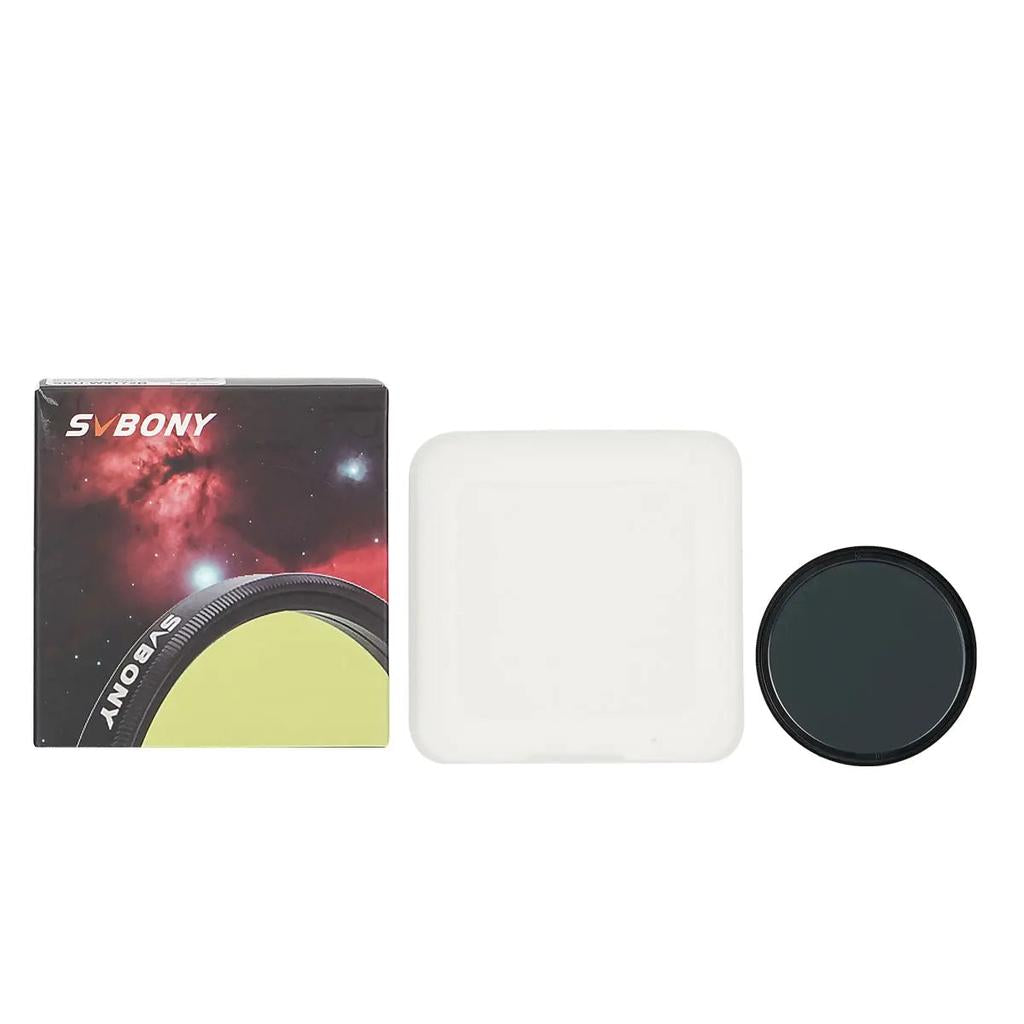
The filter is available in 1.25" and 2" sizes with M48 x 0.75 threading (for the 2" version), and is supplied in a durable PP plastic storage box for safe transport and storage.
FAQ
Q: Is this filter suitable for monochrome cameras?
A: It is optimized for one-shot color cameras, but can also be used with monochrome sensors if desired.
Q: Can I use it under a bright Moon?
A: Yes. The 7nm bandpass significantly reduces the impact of moonlight, making it useful during bright lunar phases.
Q: Which targets benefit most from this filter?
A: Emission nebulae, planetary nebulae, and supernova remnants with strong H-a and OIII emission lines benefit the most.
Q: Does it alter the overall color balance?
A: The filter selectively passes H-a and OIII lines while maintaining consistent color channels, allowing natural-looking nebula colors after standard calibration and processing.